
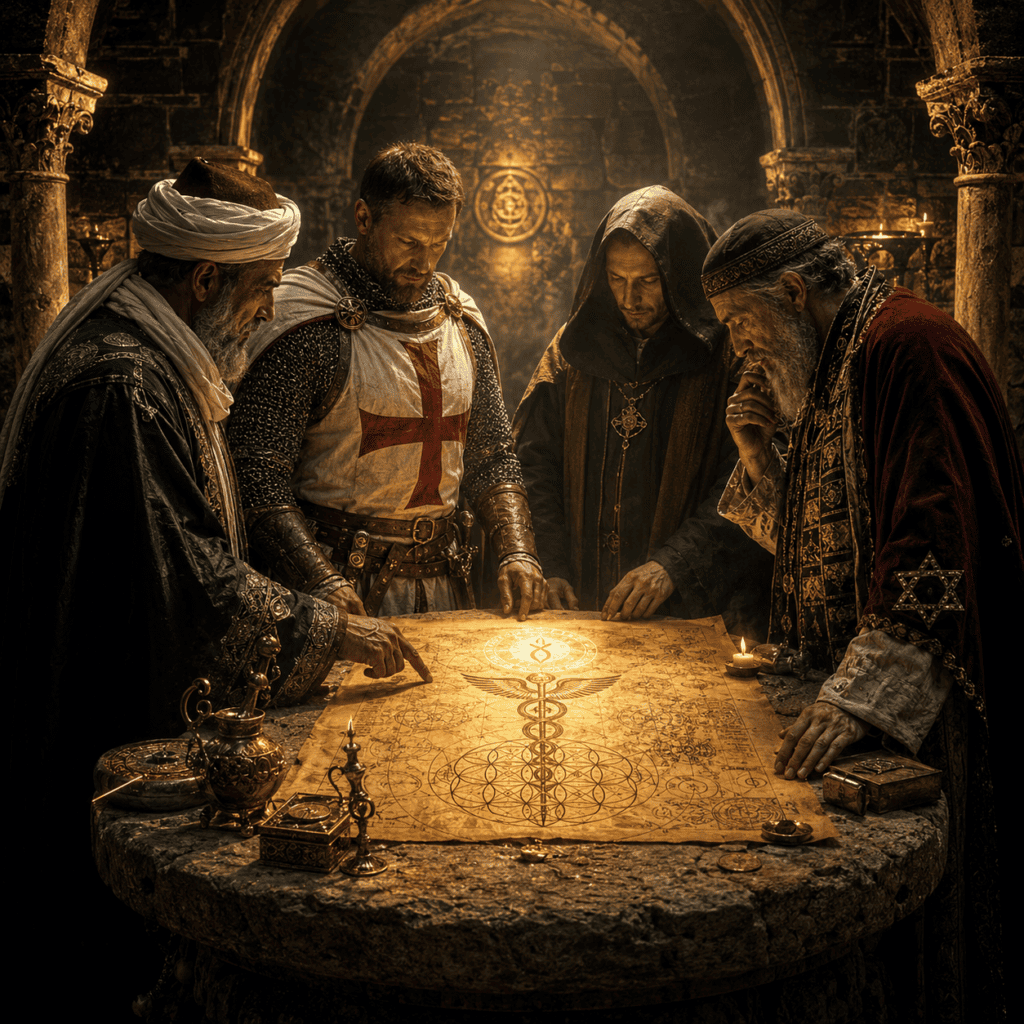
In our examination of how Gnostic wisdom travelled from the distant past to modern times, we have seen that it did not advance in a straight line, but rather it operated as a living network of interconnected points. The Knights Templar understood this perfectly. They did not seek to limit this knowledge in a rigid dogma, but safeguarded it, acting as an ecumenical nexus between different medieval cultures.
Their structure served as a protection for Gnosis. It was the perfect vehicle to connect ancient mystical currents. The knights of the order crossed dangerous borders to rescue the doctrine of self-realisation.
The Living Structure of the Gnostic Network
In the Middle Ages, preserving Gnosis demanded a bold strategy. Dogmatic persecution threatened to exterminate Gnostic schools. They were like isolated sparks of light in danger of extinction.
The Order of the Temple acted as the protective fortress of this network. Their solid organisation provided a safe haven for the initiatic centres of the region. They shielded the foundation of ancient wisdom.
This unified structure kept the key of the Three Factors of the Revolution of Consciousness safe. They did not teach abstract theories about the Being. They delivered the Gnostic practice of self-knowledge to free humanity from illusion and achieve self-realisation.
The Gnostic Connection from the Rosicrucian Perspective
The Rosicrucian manifestos from the 17th-century confirm the unbroken line of transmission from the Knights Templar. Upon dissolving their public structure, its initiates preserved the internal doctrine, alchemical transmutation and the Three Factors of the Revolution of Consciousness.
This doctrinal continuity guaranteed the preservation of the science of the spirit in the West. For more details on the topic of this transfer of knowledge, read our article on The Templar Legacy in Rosicrucianism.
The Schools of the East: Hashashins, Druze, and the Gnostic Heritage
In Syria and Lebanon, the Order of the Temple found the complement of the internal quest of its members. The Templars established direct contact with the Hashashins and the Druze, active practitioners of Oriental mysticism.
These communities were custodians of a remarkably rich Gnostic tradition. They preserved Alexandrian Neoplatonism, Egyptian Hermeticism and the legacy of Persian Manichaeism.
This mutual exchange enriched the esoteric science of the Knights Templar. Both schools understood that the doctrine of truth transcends cultural or religious boundaries.
Psychological Death in the Gnostic Doctrine of Hashashins and Druze
Both groups comprehended that the ego blocks inner illumination. The Hashashins practised the discipline of Bāṭin (باطن), the hidden aspect of the doctrine, rejecting the literal, dead letter of exterior dogma, or Ẓāhir. In this way, they disintegrated their psychological defects and the false personality.
The Druze demanded an identical mental purification for their initiates. The practitioners of both schools emptied the inner vessel (eliminated the ego) to release the trapped consciousness.
Spiritual Birth in the Eastern Schools
Hashashins and Druze practiced alchemical transmutation in secret. Both groups used the term Tazkiyat al-Nafs (تزكية النفس) to describe the transformation of creative energy.
The Ismaili initiates transmuted their energies to crystallise the superior existential bodies of the Being.
In these schools, the alchemical work was called Iksīr (الإكسير)—from which the word “elixir” originates. It was the mysterious, miraculous substance that enabled the initiate to achieve the “second birth”.
Both orders achieved self-realisation through scientific chastity. Alchemical work was central to their practice.
Sacrifice for Humanity in the Eastern Network
The third factor sealed the alliance between both mystical traditions. Hashashins and Druze risked everything to spread the science of the spirit. Their unconditional service safeguarded the teaching against persecution from the medieval Islamic establishment.
They shielded the secret teachings for seekers of truth, renouncing glory of the material world and risking their lives for pure love for the cause.
Their sacrifice kept the flame of Gnostic teaching alight. Thanks to their devotion, the keys to human liberation survived the existential dangers of the medieval era.
The Balkan Schools: Bogomils, Paulicians and the Gnostic Tradition
The Knights Templar also assimilated the mystical currents of the Balkans. They learned from the Paulicians, the Bogomils and the Bosnian Church during their travels East.
These Balkan schools preserved a dualist doctrine of Syrian and Manichaean origin. They taught the radical separation between illusory matter and the immortal spirit.
Their clandestine model of organisation showed the Templars something vital: preserving the truth required a protective shield against religious persecution.
Mystical Death in the Gnostic Tradition of the Balkans
The three Balkan groups practicised the eradication of sünd or psychological sin. The Paulicians disintegrated pride by rejecting any exterior ecclesiastical hierarchy and they eliminated other psychological defects by denying the will of the ego.
The Bogomils applied strogost or severe discipline over bodily desires. They identified each defect as a creation of the Demiurge that had to be dissolved.
For its part, the Bosnian Church demanded that its leaders (Krstjani) completely renounce worldly desire. All three currents achieved purification through the elimination of the false personality and ego.
Internal Birth in the Balkan Network
The second birth was achieved through the Consolamentum or baptism of the spirit. The Paulicians rejected physical water baptism. Instead, they worked exclusively with the Baptism of Fire.
The Bogomils practiced absolute chastity to awaken the divine force within their hidden anatomy. They considered that the transmutation of creative energy was the only way to construct the superior existential bodies.
The Bosnian Church taught this practice to its Svršitelji or perfects (those who had eliminated the ego). All three schools taught the path to incarnated the light of the Logos through this alchemical work.
Sacrifice for Humanity in the Balkan Resistance
The third factor united the destiny of these three communities in selfless service. The Paulicians secretly taught Gnosis and actively defended those persecuted by the Empire.
The Bogomils travelled through the countryside as itinerant preachers without material possessions. They spread the keys of Gnostic liberation, facing the constant threat of death at the stake.
The Bosnian Church founded the network of Gost (guest houses) to assist the destitute free of charge. All three currents laid down their lives to protect humanity, delivering the keys of self-realisation as the way to end human suffering.
The Cathars in Occitania and the Network of Transmission of Gnosis
In the south of France, the Balkan tradition found its most prosperous refuge among the Cathars of Languedoc. This community established a protective alliance with the Order of the Temple. Together, they shielded Gnosis from the Inquisition.
If you wish to learn more about their practice of transmutation – the Endura – and the history of this initiatic school, read our complete analysis of the Cathar doctrine of Occitania.
The Gnostic Synthesis of the Iberian Peninsula: Sufis, Kabbalists, and Templars
The Iberian Peninsula could be seen as a transdisciplinary laboratory for esoteric study. Within its Christian and Hispano-Muslim kingdoms, Sufi alchemy, Kabbalah, and Hermeticism converged.
This alliance was protected by the Templar command. The knights created protected zones that shielded scholars from the Inquisition, enabling the continued transmission of Gnosis.
The Nigredo and the Dissolution of the Qliphoth in Gnostic Mystical Death
Sufis, Kabbalists, and Hermeticists approached the death of the ego with precise methods.
Sufi alchemy applied Tazkiyat al-Nafs to dissolve animal passions.
Iberian Kabbalah taught the descent into the Qliphoth to extirpate the psychological shadow (ego).
For their part, Hermeticists experienced this purification in the Nigredo or putrefaction of matter. This stage symbolised the dissolution of psychological aggregates.
All schools concurred that dissolving the psychological aggregates releases the light of consciousness.
The V.I.T.R.I.O.L. Formula and Spiritual Birth in Yesod
The second factor required the transmutation of creative energy. The Sufis practiced transmutation to nourish the Rūḥ or divine spirit.
The Kabbalists of Toledo located this work in the foundation Yesod, the ninth Sephirah of the hidden anatomy of the human. They taught the pure union of polarities to crystallise the superior existential bodies of the Being.
The Hermeticists encoded this science in the acronym V.I.T.R.I.O.L. Through the fire and mercury of nature, all these schools achieved the birth of the True Man.
Tikkun Olam and the Gnostic Sacrifice for Humanity
The third factor was expressed in the Peninsula under the Kabbalistic concept of Tikkun Olam or the rectification of the world. Initiates risked their lives to translate and disseminate the forbidden science.
Sufi physicians and Jewish initiates offered their wisdom free of charge to the poor. Their conscious sacrifice for humanity allowed their spiritual essence to grow.
This unconditional service united three distinct cultures in a single cause. A love for Gnostic truth overcame the religious dogma and persecution of the times.
Baphomet and the passing into secrecy of the Gnostic Tradition
The dissolution of the Knights Templar in 1307 by King Philip IV and Pope Clement V was not simply a political matter. The Inquisition persecuted the knights for possessing the keys to initiatic science and for unifying the mystics of the East and West.
Baphomet, far from being a demonic idol, represented the synthesis of sacred alchemy. Its symbols (Sun, Moon, Caduceus, and Fire) encoded the transmutation of creative energy and the awakening of consciousness.
By destroying their fortresses and routes, the secular and religious powers merely destroyed an organisational structure. The survivors dispersed across Scotland, Spain, and Portugal, submerging the teaching into the silence of secret fraternities.
The Baphomet Cipher and the Continuity of the Gnostic Current
Baphomet concealed a precise cryptographic key. Applying the Atbash cipher (a Hebrew substitution system) to the word Baphomet yields the Greek word Sophia, meaning Wisdom.
The Templars did not worship an idol. They guarded the Hermetic symbol of divine androgyny and alchemical transmutation.
When the external structure of the Templar Order was destroyed, this science did not perish. It went underground. Its influence nourished the later emergence of Hermetic texts in Europe, a phenomenon you can explore in our study on the Rosicrucian Order.
From a Medieval Network to the Tapestry of the Future
This teaching was never transmitted as a single, fragile thread dependent on any one organisation. It functioned as a living, decentralised and indestructible network.
Paulicians, Bogomils, Cathars, Sufis, and Kabbalists were the threads of this spiritual tapestry. The Knights Templar acted as the primary receiving point. They gathered and protected that accumulated wisdom against the prevailing dogmatism. Whenever one point in the network fell, the light reappeared in another region. This clandestine structure ensured the transmission of Gnostic teachings across the centuries.
This was made possible by the absolute dedication of its guardians. Hundreds of initiates laid down their lives, burned at the stake of the Inquisition, so that Gnosis was not lost.
They did not seek personal glory or to establish permanent institutions; their sole purpose was to keep the science of the spirit alive for future generations. Thanks to the resilience of that network, the Gnostic teaching remains accessible today.
From Stories of the Past to the Practice of Gnostic Teaching
Historical knowledge carries no value unless it is transformed into direct experience. The initiates of the Middle Ages did not risk their lives for theories, but to apply Gnostic science within their own psychology.
If this analysis of the esoteric lineage has awakened a feeling of inquiry within your own consciousness, active practice is the next step.
Take the Next Step in Your Gnostic Practice
True knowledge is entirely experiential. To apply the Three Factors of the Revolution of Consciousness in practice requires proper guidance.
If you wish to deepen your understanding of these teachings and receive information about our courses, contact us directly via WhatsApp. Click the button on this page to begin your journey today.
We also invite you to subscribe to our blog and share this article with fellow seekers of truth.
Subscribe to our blog!