
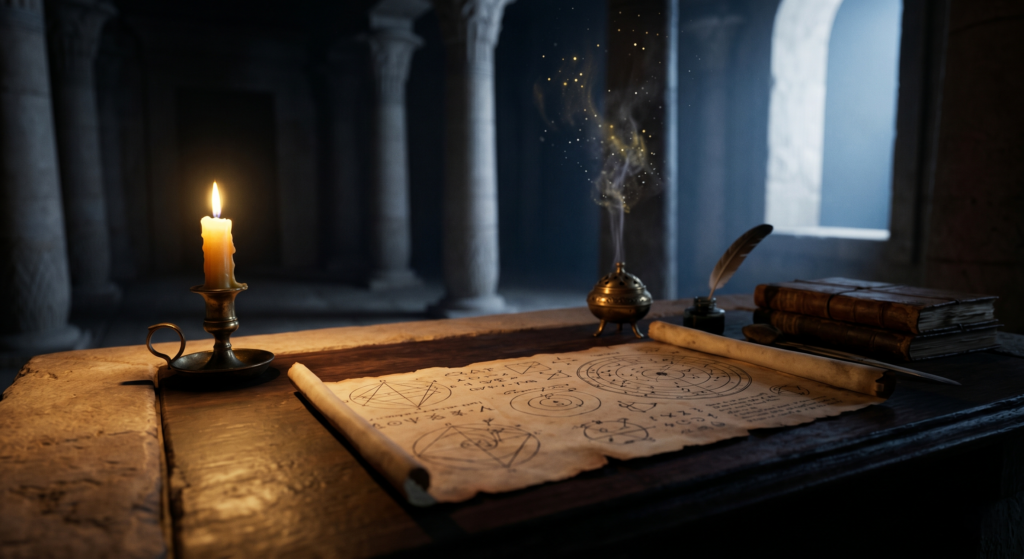
Do you feel that you are searching for something deep within you? Do you feel a yearning for something you don’t have a name for, but you feel like it holds the answer to all your questions? This mystical longing is not a casual emotion. It is the impulse of your Essence, trapped in matter, longing for its liberation. In the third century, an esoteric current addressed this great mystery with absolute precision. We refer to Neoplatonism. This ancient mystery school opened the vertical path towards the awakening of the soul.
Plotinus and the Origin of Neoplatonism
The persecution of early Gnosis forced its sages to disperse. Eastern Manichaeism was also under constant attack on the borders of the empire. This meant that the secret wisdom needed a new vehicle in the West.
In the third century, the master Plotinus assumed this historical mission in Rome. He gathered the mystical essence of those persecuted schools, including the hidden teachings of the philosopher Plato. As a direct result of that transition, this mystical current adopted the name of Neoplatonism.
Plotinus united the keys of Gnosis with classical Greek doctrine. He considered himself simply authentically Platonic. Historians added the prefix “neo” centuries later.
This master wrote his spiritual experiences in a fragmentary way. It was there that his most brilliant disciple, Porphyry of Tyre, from Phoenicia, emerged to give structure to the doctrine.
Porphyry organised his master’s writings into the Enneads. Without his esoteric rigour, the teaching would have been lost. Together, they carefully safeguarded the Doctrine of the Being.
This school carried forward the Gnostic legacy, dressed in philosophical clothes. This was not found an external religion for the masses, but a path oriented towards the awakening of the soul.
The Re-ligare in Neoplatonism
The spiritual Essence does not belong to this material world, but rather is trapped in physical forms. The fundamental objective of existence consists in liberating this Consciousness to achieve union with the Divine.
We call this process of inner unification and spiritual return towards our divine origin the re-ligare. This mystical reconnection constitutes the core of Neoplatonism: the journey of the Consciousness to its original source.
The doctrine teaches that the divine Spark must ascend to the Absolute through a personal and voluntary effort. The re-ligare is not a passive fusion, but a fully awakened reintegration with our own inner Being.
Psychological Death through Catharsis
Plotinus taught that the Essence must cleanse itself of material impurities to begin its spiritual ascent. The ancient masters called this process of radical purification by the Greek term Catharsis.
In contemporary Gnosis, Catharsis corresponds exactly to the work of psychological death. It is not a merely intellectual purification or a repentance based on abstract theories.
Today’s student applies this discipline through constant self-observation in their daily life. Upon discovering a mechanical reaction, such as anger, they comprehend the defect and ask for its dissolution. This is how we liberate the trapped Consciousness and effect the re-ligare.
Porphyry’s Contribution to Neoplatonism
Porphyry took over the direction of the school after the death of Plotinus in the third century AD. His great contribution was to organise and edit all the texts that his esoteric guide had left in different places.
In this way, he saved the doctrine of the awakening of Consciousness from being lost in time. By organising the Enneads, he left a clear map for the daily work of intimate self-observation.
Hypatia and Fourth-Century Teaching
This esoteric current reached its maximum expression with the master Hypatia. She directed the Gnostic school of Alexandria during the fourth century A.D.
Hypatia taught mathematics and astronomy as scientific disciplines to purify the mind and Consciousness. Her work demonstrated that objective science also constitutes a practical tool for the re-ligare.
Iamblichus and Theurgy
The master Iamblichus reformed the school during the fourth century. He taught that the intellect is insufficient to liberate the Essence. Therefore, he introduced theurgy into Neoplatonism as a practice of divine magic.
The central objective of theurgy is to achieve mystical union with the divine. The true theurgist seeks to know the will of their Real Being in order to act as a clear and clean channel. Through this sacred work, the student seeks to awaken Consciousness directly.
The practice includes the use of specific mantrams to raise the inner vibration. The power of these sacred words resides in their pure vibration. When pronounced correctly, an energetic shock is generated that influences the Consciousness.
With that elevated force, the devotee enters into deep meditation. Thus, they invoke their Divine Mother (inner spiritual force) to dissolve the comprehended defects. This practice leads the student to the re-ligare.
Proclus, Valentinus and Neoplatonism
The master Proclus put into detailed order the different spiritual hierarchies that govern the entire universe. His valuable work demonstrated that the eternal principles of Gnosis are expressed in different eras. This perennial wisdom united the ancient teaching of Valentinus with the cosmic map of Neoplatonism.
Both masters explained that the Essence descends through the higher dimensions. To reascend through those dimensions, deep meditation is the indispensable tool that we need to use. This scientific discipline allows us to comprehend the aggregates and eliminate the discovered psychological defects that hold our Essence trapped in matter.
Thus, mystical death liberates the divine energy that is needed to fabricate the soul
The Synthesis of Neoplatonism
Neoplatonism was not a mere philosophical theory of the ancient past. This mystical school kept the flame of secret, perennial and universal knowledge – Gnosis – alive. Its practical teaching delivered the exact keys for the intimate self-realisation of the Being.
Nowadays, contemporary Gnosis rescues these same fundamental principles of transformation: self-observation, profound meditation and theurgy remain fully valid tools. Through them, today’s student manages to dissolve their defects and awaken consciousness.
Help Others Find the Way
The study of the Doctrine of the Being is a demanding path. We receive light to walk it when we share wisdom with others. If this exploration of Neoplatonism has resonated within your consciousness, join our Gnostic community:
Share this article: Help the Light of Gnosis reach more people. Spread this mystical knowledge on your social networks with friends who are seeking their awakening.
Subscribe to the blog: Leave us your email address right here. You will receive the practical keys for the Great Work directly in your inbox.Leave your comment: We would love to receive your reflections on the article. Which aspect of theurgy or meditation do you consider most difficult to apply daily? Write below and let us open an esoteric conversation!
Subscribe to our blog!