
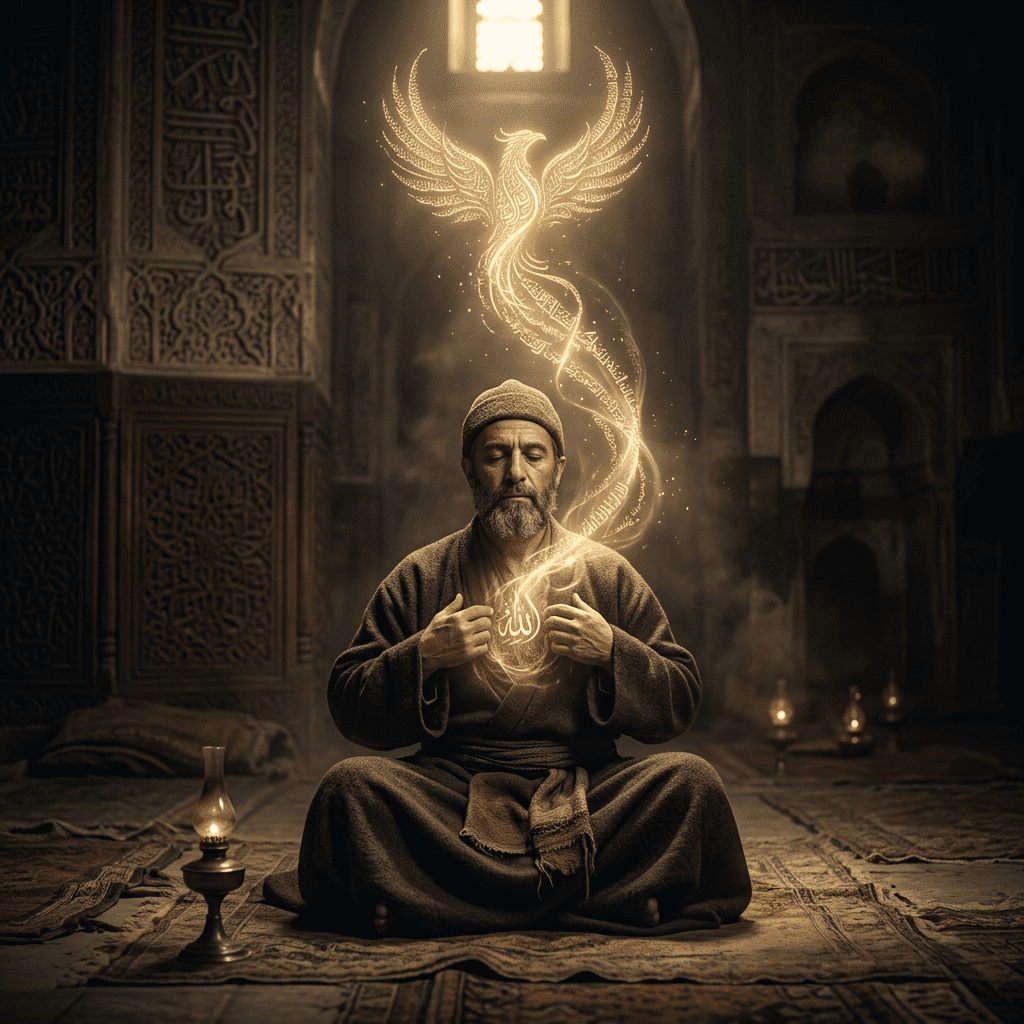
You may be wondering how the lineage of Gnosis continued after the early centuries A.D. Many believed that its flame was extinguished in the seventh century, as political and religious interests closed down the centres of wisdom in Europe. To survive, the torch of Gnosis was carried towards the Arabian desert, where it flourished and became what we know today as Sufism.
A mysterious chain of custodians of this sacred knowledge crossed the Arabian desert in secret, during the dark ages of Europe. They adopted a new language and an unexpected attire for it and, in this way, they protected the science of the liberation of the soul.
In the East, this group of seekers began a revolutionary discipline. Their practice challenged the literal reading of sacred texts. They guarded an intimate secret that today, more than ever, needs to be unveiled to understand the true awakening of consciousness.
The Threads of the Perennial Wisdom in Sufism
This was not a new invention. It was the same flame that had already illuminated entire civilisations. The mystical current of Sufism did not emerge in isolation in the desert, but absorbed the knowledge of the traditions we have studied in previous articles.
An unbreakable thread connects this Eastern wisdom with the past. The Sufi masters rescued the rigorous discipline of the Essenes. They also inherited the inner transmutation of the Nazarenes and the profound science of transmutation from Hermeticism.
Even the theurgy of Neoplatonism crossed borders to integrate into their practices. In this way, Sufism became the perfect vessel for the Perennial Wisdom in the Middle East. They changed Greek and Egyptian words for Arabic terms, whilst keeping intact the same aim: the self-realisation of the Being.
The Historic Origins of Esoteric Sufism
To understand how this chain of guardianship was formed, we go back to seventh century Arabia. The origin of the word Sufism comes from suf, meaning wool, due to the simple garments of the first ascetics. Its esoteric root goes much further.
The Prophet Muhammad did not present Sufism as a formal institution. He transmitted Ihsan: inner spiritual practice. In the mosque of Medina a group of radical seekers, direct disciples of the Prophet, were known as Ahl al-Suffa, or the “People of the Portico”.
These serious seekers of knowledge assimilated the secret core of his teachings. They separated themselves from the noise of the world, rejecting worldly and political ambitions, living in strict voluntary poverty.
They dedicated their days and nights to deep meditation. They practised a rigorous intimate self-observation. They held the secret chain of guardianship that gave life to Sufism and ensured that the practical doctrine of the Revolution of Consciousness was not lost.
Al-Jihad al-Akbar: The First Factor of Sufism
The work within this mystery school begins with a radical battle. This battle is fought within the inner universe of the human being. In Sufism, the first factor of the Revolution of Consciousness is known by the term Al-Jihad al-Akbar. It translates exactly as “The Greater Jihad”.
Al-Jihad al-Akbar represents the internal battle against the ego. The purification of the soul through discipline, prayer, repentance, charity and the remembrance of God.
This battle has nothing to do with physical violence or waging war against other people. The Prophet Muhammad taught that the most sacred and complex struggle is the daily battle against oneself. In other words, against the defects that imprison our divine essence.
To advance in Sufism, the student must learn to study the anatomy of their own ego. In this study, the disciple must progress through different stages. Each stage precisely reflects a level of purification.
- Nafs al-Ammara: Represents the pluralised ‘I’ that is ruled by passions, pride, greed, anger, etc. It is the mechanical state where the ego completely dominates the human machine.
- Nafs al-Lawwama: This is the essence that self-observes and accuses itself. This state arises when the student activates intimate self-observation. They discover their own errors and feel the weight of the judgment of their conscience.
- Al-Fana: is the ultimate goal of psychology in Sufism. It consists of the mystical annihilation or radical dissolution of the ‘I’. Only through the death of the ego is it possible to release the original Spark so that the Divinity acts without interference.
Inner Alchemy and Spiritual Rebirth in Sufism
After the seeker understands the need to dissolve the ego, Sufism unveils its second pillar: Spiritual Rebirth. This transformation comes, not through the simple belief in a dogma, but through a rigorous transmutation of the creative energies.
The great alchemist masters of the medieval Islamic world expressed this science in highly symbolic language. The mystic Al-Ghazali wrote a famous work called “The Alchemy of Happiness”. He revealed that the true human laboratory is within our own inner universe.
In the path of Sufism, this alchemical process is clearly defined. It consists of cleaning the base metals of our lower nature to make the sacred garments of the Spirit:
- The Transmutation of Nafs: The creative energy is normally wasted in the passions of the animal nature or Nafs. It must be wisely redirected and refined through voluntary effort and a pure life.
- The Gestation of Ruh: By transmuting the creative energy, the divine Spark ascends through the internal anatomy of the student. This allows the birth of Ruh or pure Spirit.
This building of the inner man is a scientific and mathematical process. Sufism teaches that it is indispensable to create the internal bodies of the Being so we can consciously inhabit the superior dimensions.
Ithar: The Third Factor and Conscious Sacrifice
Within the mystical school of Sufism, spiritual ascent cannot be sustained if the work is done to benefit only ourselves. Whilst the student transmutes their energy and eliminates their psychological defects, there is also an obligation of sacrifice. Cosmic law demands the fulfilment of the third factor: Sacrifice for Humanity.
In the original doctrine, this factor is expressed through the word Ithar, which translates as conscious altruism. The practitioner of Sufism must be altruistic. They must place the needs of their neighbour before their own interests.
The true initiate does not seek to enjoy mystical ecstasy isolated in a cave, far from the pain of his fellow men. The duty of every master in Sufism is to become a pure channel of divine grace. This connection between the divine and the human is known as Baraka.
Through Ithar, the mystic delivers the Light of knowledge selflessly to those who still walk in darkness. Unconditional love for all creation becomes an active force. It is a conscious payment that balances the scales of celestial justice. This allows the seeker to receive greater internal guidance for their own self-realisation.
The Science of Dhikr: The Sufi Theurgy
To sustain the work of the Three Factors of the Revolution of Consciousness, Sufism uses a practical tool. This tool of a theurgical nature is known as Dhikr, or the continuous remembrance of the Divinity. The venerable master Samael Aun Weor calls it self-remembrance.
This technique connects directly with the classical theurgy that we saw when studying Iamblichus and the school of Neoplatonism, whose students also used mantrams that allowed them to create a suitable inner state.
Just as Iamblichus used ineffable words to invoke the Being, the masters of Sufism teach that the sacred names of the Absolute have the power to alter the internal vibration of the student.
The Eastern masters affirm that the ordinary human mind is in a state of deep sleep and collective hypnosis. By practising these mantrams – some of them being the ancient invocation formulas of Egyptian Hermeticism – a special vibratory level is generated.
This vibration purifies the psychic structure, quiets mechanical thoughts and raises the vital energy towards the superior centres. Through Dhikr, the theurgy of Sufism manages to break the sleep of consciousness. This gives the seeker a glimpse of objective reality. With their consciousness more awakened in this way, they have the strength needed to continue the arduous battle against their psychological aggregates.
Conclusion: The Separation of Dogma and the Essence of Sufism
Understanding the trajectory of this mystery school allows us to assimilate the anatomy of religions.
Primitive Gnosis was the original esoteric core, but it was subsequently persecuted by the Christian ecclesiastical institution. In the same way, Sufism forms the mystical core buried in the dogmatic structures of institutional Islam.
External forms, presentation and language inevitably change over the centuries. However, the internal doctrine of self-realisation remains identical at its core. The history of Sufism reminds us that the map to universal wisdom is aways there to be found by true seekers of the light of Consciousness.
This exact path awaits those willing to seek Haqiqa, the Truth, far beyond the dead letter.
Join the Esoteric Conversation!
If this journey through the secrets of the Middle East has inspired you, we invite you to take two conscious actions to expand this Light:
- Share this article: Help spread the wisdom of the Mystery Schools by sharing this link on your social networks with other seekers who, like you, yearn for the awakening of consciousness.
- Subscribe to our blog: Leave your email in the form below to receive the practical keys of the Great Work directly in your inbox.
- Leave your comment below: What aspect of Al-Jihad al-Akbar do you find most challenging to sustain in your daily psychological self-observation? We want to hear your experience!
Subscribe to our blog!