
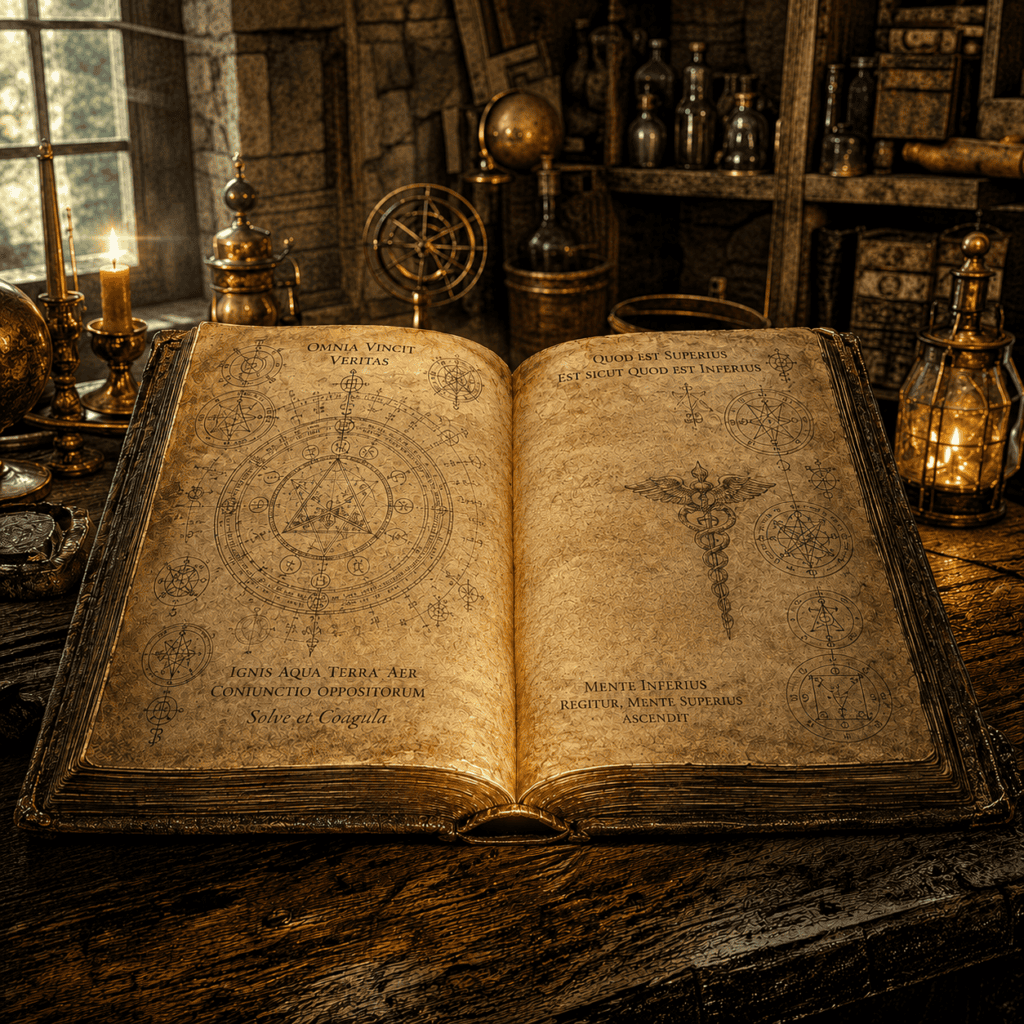
Renaissance Hermetism and Its Secret Chain
What was the fate of the ancient wisdom following the tragic fall of the Templars in 1307? The medieval Inquisition attempted to erase every trace of living Gnosis. However, Renaissance Hermetism proved that the light of truth can never be destroyed.
The initiatic chain seemed broken after the persecutions and executions by burning at the stake that marked the fourteenth century. The mystery schools lost their visible physical structures and their knowledge seemed to vanish. In reality this practical knowledge on human transformation did not vanish, it merely went into a period of deep rest.
The wise guardians of the science of self-realisation kept their secret knowledge safe, waiting for the right moment for it to reappear and flourish in new, fertile soil. That opportunity arrived in the prosperous Florence of the fifteenth century. Gnostic teaching was reborn under a completely renewed philosophical language: Renaissance Hermetism arose as the living answer for seekers of truth.
The ancient knowledge of Alexandria returned to awaken sleeping consciousness. This wisdom offered practical tools for working upon oneself. In this article you will discover how this secret chain protected Gnosis.
From the Medieval Network to Renaissance Hermetism
Following the fall of the public mystery schools, Gnosis needed a new vehicle of transmission, moving seamlessly from the medieval network to Renaissance Hermetism.
Despite the persecution of the holders of wisdom, the science of the spirit was not lost. It was kept alive thanks to the silent work of initiatic fraternities that were well prepared to safeguard it. These groups concealed the science of self-realisation under ingenious, artistic veils.
Comprehending how this historical bridge operated allows us to value the continuity of the chain of transmission of initiatic knowledge. The light of truth always finds ways to reach the sincere seeker.
The Fedeli d’Amore in Gnostic Transmission
The Fedeli d’Amore fulfilled a fundamental role as a clandestine bridge between the fourteenth and fifteenth centuries. This secret order of poets included the great initiate Dante Alighieri amongst its ranks.
They used poetry and courtly love to shield the transmission of knowledge from the Inquisition. Behind their romantic verses, they concealed Renaissance alchemy and the sacred cult of the Divine Sophia.
The beloved woman of their poetry was no earthly being. She represented the divine soul and the eternal Wisdom that we must incarnate. Through allegorical language, they taught the transmutation of creative energies and psychic purification.
Thanks to their veiled work, primitive Gnosis survived intact. The preservation of these practical mysteries prepared the ground for the arrival of Renaissance Hermetism.
The Corpus Hermeticum in Renaissance Hermetism
The year 1460 marked a decisive turning point for the secret wisdom in the West. A Byzantine Greek manuscript arrived in the prosperous city of Florence. This text contained the sacred Alexandrian writings known as the Corpus Hermeticum.
The arrival of this document caused the science of the spirit to resurface, propelling the development of Renaissance Hermetism.
Seekers of that time rediscovered the keys to comprehending the universe and carrying out an inner work. Ancient Gnosis was once again available for those seeking the awakening of human consciousness.
Marsilio Ficino and the Translation of Florence
Upon receiving the sacred text, the ruler of Florence, Cosimo de’ Medici, made a momentously important decision – he commanded Marsilio Ficino to translate the Corpus Hermeticum immediately.
Medici demanded this work be completed even before translating the famous works of Plato, giving Gnostic wisdom absolute priority.
Ficino comprehended that human beings possess an inner divine spark. His work of translation laid the foundations of Renaissance Hermetism, giving humanity the direct map for self-realisation and the awakening of consciousness once again.
Christian Kabbalah and Magic in Renaissance Hermetism
The fifteenth century succeeded in uniting apparently disparate sacred currents of the past. Natural magic and Hebraic mysticism intertwined powerfully within Renaissance Hermetism.
This union was no simple theory. Rather, it represented the creation of a comprehensive system for psychological work and inner self-realisation. Ancient wisdom delivered practical tools to transform human destiny.
By integrating these teachings, it was demonstrated that human beings have the potential to direct their own energy. You will now discover how this potent spiritual synthesis underpins the revolution of consciousness.
Pico della Mirandola and the Dignity of Man
The philosopher Pico della Mirandola occupied a central role in this great initiatic synthesis. He masterfully united the Hebraic Kabbalah and the Egyptian knowledge preserved in the Corpus Hermeticum.
Mirandola demonstrated that a person is not a passive victim of fate. We possess free will to shape our own inner state. This teaching gave strength to the practical pillar of Renaissance Hermetism.
Through self-observation and discipline the student dissolves the bonds of the mechanical ego, thus rising to higher levels of Being.
The Three Factors of the Revolution of Consciousness in Renaissance Hermetism
The secret teaching was never mere theoretical speculation. The true greatness of Renaissance Hermetism lies in its practical methodology for revolutionising consciousness.
The sages of that time applied the Three Factors methodically. In the language of Alchemy, they transformed the lead of personality into the pure gold of the Spirit.
This science demands constant work upon oneself. Below, we explore how each factor was applied through Renaissance texts and experience.
Psychological Death in Renaissance Hermetism
Tractate XIII of the Corpus Hermeticum teaches the dissolution of the twelve vices or tormentors of matter. This alchemical stage of Nigredo represents the rigorous death of psychological aggregates.
Renaissance sages applied self-observation and deep reflection to purify the mind. By eliminating the ego, the trapped divine Essence is liberated from psychic darkness.
Spiritual Birth in Renaissance Hermetism
The second factor was experienced through Palingenesis or the second spiritual birth. Through Renaissance alchemy, the practitioner learns to transmute their creative energies.
This transmutation brings about the creation of the Solar Bodies, the superior vehicles that enable the incarnation of divinity in the person.
Giordano Bruno and Sacrifice in Renaissance Hermetism
The third factor of the revolution of consciousness demands the giving of one’s life and knowledge out of love for humanity. The great initiate Giordano Bruno incarnated this principle of supreme sacrifice with absolute courage.
Bruno spread Gnosis without fear of the dogmas of his era. He preferred to suffer martyrdom at the stake rather than recant the truth.
His example demonstrates the commitment of Renaissance Hermetism to human liberation. Love for humanity impels the student to give everything for the awakening of others.
Apply the Principles of Self-Knowledge
The intense work of Ficino, Mirandola, and Bruno did not exist in isolation. The impetus of Renaissance Hermetism perfectly prepared the ground for the emergence of the seventeenth-century Rosicrucian Manifestos.
This unbroken chain of wisdom keeps the flame of Gnosis alive for today’s seeker. Now it is your turn to apply these principles of self-knowledge in your daily life.
Would you like to help this light reach more seekers of truth? Share this article on your social networks and spread ancient wisdom.
Subscribe now to the blog to continue discovering the mysteries of our esoteric series.
If you feel the impulse to expand these studies and wish to learn Gnosis in a practical and guided way, write to us directly by clicking on the WhatsApp button on this page.
Subscribe to our blog!