
The Secret Origin of the Fedeli d’Amore
How did Gnosis survive the fires of the Inquisition? After the fall of Montségur (1244 AD), the Cathar torch seemed to have been extinguished. However, the Occitan initiates implemented a daring strategy for survival. They crossed the Alps into Italy and camouflaged the Gnostic doctrine within poetry. In that underground refuge, the Fedeli d’Amore (the Faithful of Love) were born. This brotherhood protected Gnosis through the arts.
The Inquisition and the Refuge of the Fedeli d’Amore
In the thirteenth century, the persecution of Gnosis by the Church meant that this mystical wisdom had to be concealed to avoid its practitioners being burned at the stake. The Fedeli d’Amore met in the strictest secrecy and designed a system of passwords and keys to recognise each other in public spaces without raising suspicion.
Their genius was to disguise theology in poetry, so that their persecutors saw only simple romantic songs. In this manner, the brotherhood protected the practical maps of intimate self-realisation.
The Exodus of the Occitan Troubadours
The troubadours of Occitania were initiates who transmitted the science of transmutation through art. Fleeing the Inquisition in France, they crossed the Alps towards Italy to save the secret doctrine.
There, the Fedeli d’Amore channelled Occitan Gnosis into the Dolce Stil Novo (the Sweet New Style), using the Tuscan language as the new clothing to protect the initiatory lineage.
The Masters Behind the Fedeli d’Amore
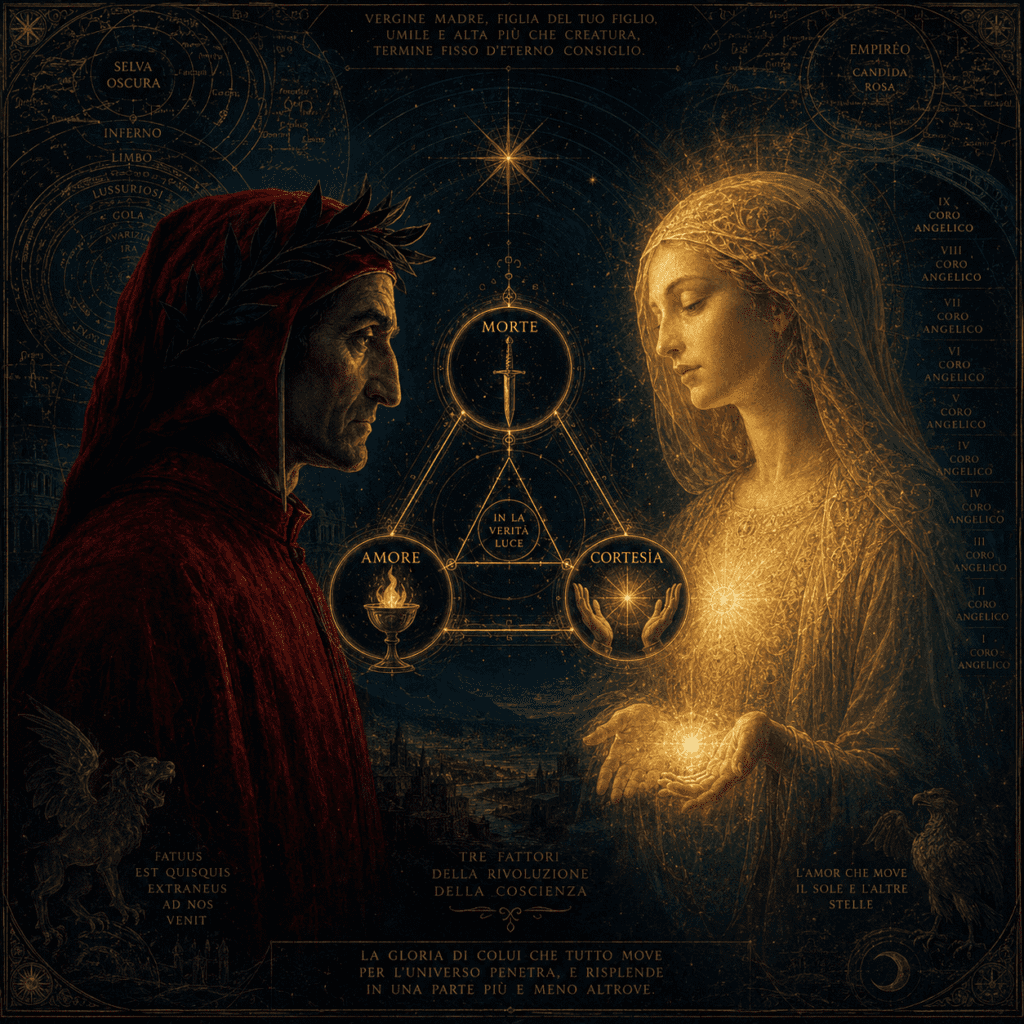
The Fedeli d’Amore were organised as an initiatory hierarchy based on internal work. Far from being mere poets, these spiritual masters structured the hermetic code that embodied the Three Factors of the Revolution of Consciousness in immortal works.
Guido Guinizelli and the Doctrine of the Gentle Heart
Guido Guinizelli, founder of the Dolce Stil Novo, translated the Cathar mysteries, laying the esoteric foundations for the Fedeli d’Amore. For this master, the “gentle heart” (corazón gentil) was not an emotional feeling but a pure internal state, indispensable for the light of the Being to express itself.
He affirmed that spiritual lineage is not something that can be inherited by birth, but has to be achieved through working upon oneself and practical transmutation. He prepared the way for Dante.
Dante Alighieri: The Grand Master of the Fedeli d’Amore
Dante Alighieri represents the spiritual pinnacle of the order of the Fedeli d’Amore. He was its supreme Grand Master in Italy. His poetic works are a scientific map and an alchemical drama designed to achieve intimate self-realisation.
The descent into the hells described in his Divine Comedy, symbolises the work in the Ninth Sphere, which is an indispensable key for the transmutation of energy and the elimination of psychological aggregates. Through its sacred cantos, the master consolidated the science of the spirit, while avoiding the attention of those who would censor these teachings, and successfully guiding seekers towards the light of the Being.
La Mujer and the Mystery of the Donna Angelicata
The poetry of the Fedeli d’Amore revolves around a mystical feminine figure. This is not an actual person, but is the Donna Angelicata, or celestial woman, a figure that embodies the power of the eternal feminine principle of creation.
As an alchemical key, this divine woman represents spiritual purity and the force that inspires work in the Ninth Sphere. Without the feminine polarity, it is impossible to kindle the sacred fire of transmutation; she is the gate of Eden and the guide of the soul.
The mystical union with the Donna Angelicata demands the death of the animal ego, for only a gentle heart may assimilate her virtues. Through this mystery, the Fedeli d’Amore taught scientific chastity, transforming human love into a tool for absolute liberation.
Beatrice: The Esoteric Symbol of the Fedeli d’Amore
Official history has tried to pin down the identity of Dante’s muse to a historical Florentine woman, but for Gnosis, Beatrice is a cosmic principle and a spiritual reality that transcends the physical; reducing her to an earthly woman destroys her profound initiatory meaning.
She represents Divine Wisdom—the Divine Mother Kundalini or Sophia—and the Divine Soul (Buddhi). She is the inner light that guides the initiate through the abyss and the force with which that the seeker yearns to unite.
The Fedeli d’Amore addressed the lady in poetry as a way to conceal the mystery of the Great Work. Adoring the muse demanded the transmutation of sexual energy. The Venerable Master Samael Aun Weor explains that the Divine Mother Kundalini is adored with chastity. Thus, the symbolic language of poetry protected the science of transmutation and the lineage continued.
The Divine Comedy: The Alchemical Manual of the Fedeli d’Amore
This crowning masterpiece constitutes the alchemical navigation map of the Fedeli d’Amore. With precision, each canto describes the stages of the Great Work and the processes necessary to liberate the consciousness trapped within the ego.
The journey represents the path of esoteric initiation: the descent, the purification, and the ascent of the soul. Camouflaged among medieval characters, the elements of the work demand the mastery of internal forces and work with the sacred fire.
The Inferno and the Psychological Abyss
Dante’s Inferno is the map of the Fedeli d’Amore for the work of purification. This descent takes the seeker from the surface to the depths of their psychological world, demanding first the mastery of basic instincts and then the more subtle traps of the intellect.
Each circle represents heavier atomic levels of the animal ego. As the initiate ventures deeper into the abyss, they face everything from their most subtle defects to inner betrayal and denser psychological elements. In this way, Dante demonstrated that psychological work requires method and patience.
After clearing the abyss, the seeker purifies their internal bodies through the sacred fire of Purgatory to ascend to Paradise. Thus concludes the Great Work, transforming the lead of the personality into the pure gold of the Spirit.
The Three Factors of the Revolution of Consciousness within the Order
The secret science of the Fedeli d’Amore is synthesised into three practical aspects. Without these Three Factors, radical transformation and the intimate self-realisation of the Essence remain impossible.
Morte: The Torment and Mystical Death of the Fedeli d’Amore
The first factor demands the destruction of psychic aggregates. The poets termed this process Morte (death), where the lyrical suffering of not reaching the beloved symbolised the radical inner struggle against the ego.
To unite with Wisdom, the initiate lived the Cathar Endura: the dissolution of the “I” and the elimination of base passions. This radical purification liberates the Essence, converting mystical torment into the voluntary suffering of psychological death.
Amore: The Laboratory of the Fedeli d’Amore and Transmutation
The second factor consists in channelling energy through the sacred intimate union of man and woman. The poets affirmed that divine Amore (Love) only dwells within the “gentle heart”—a concept that directly alludes to the human laboratory and internal alchemy, not, as many imagine, to simple social courtesy.
For the order, the word AMOR was a secret code. Based on Latin and the Provençal language of the Cathars, it also functioned as a mantra: A-MORS (Without Death).
“Amor”, as a mystical force, was the initiatory path to transcend death. In this manner, the initiates into these mysteries achieved illumination and attained union with their Real Being, securing the immortality of the soul.
Cortesía: The Art and Sacrifice of the Fedeli d’Amore
The third factor gives the initiate the impulse to pass on the knowledge through the virtue of Cortesía (Courtesy). Risking their lives, the brotherhood spread the secret teachings of Gnosis through songs and poetry. Anyone who had ‘eyes to see’ was able to discover the keys to emancipation hiding in plain sight.
In this way, they fulfilled the duty of sacrifice for humanity, delivering the keys and maps for the awakening of consciousness. Through this selfless service, they won the right to advance upon the spiritual path.
The Legacy of the Fedeli d’Amore
The message of these medieval poets is alive today. Their songs concealed an exact map of internal transformation, demonstrating that true and objective art serves exclusively to awaken the sleeping consciousness.
The mystery of the lady and the Dantesque path gain true meaning in practice. Whosoever learns to die within themselves and to be reborn internally incarnates wisdom and achieves intimate self-realisation.
Your Opinion and Motivation are Valuable!
If this journey through the secret history of Gnosis has brought light to your inner search, we invite you to become an active part of our community:
- Share this article with those seekers who yearn to understand the mysteries of the science of the Spirit.
- Subscribe to the blog so you do not miss the upcoming instalments of this Mystery Schools series.
- Leave a comment below sharing your reflections or questions on Dante’s esoterism.
Do you wish to go deeper into this teaching?
If you would like to register completely free of charge for our upcoming Gnosis Course, click right now on the WhatsApp button appearing on your screen and ask to participate. Knowledge is for everyone!
Subscribe to our blog!