
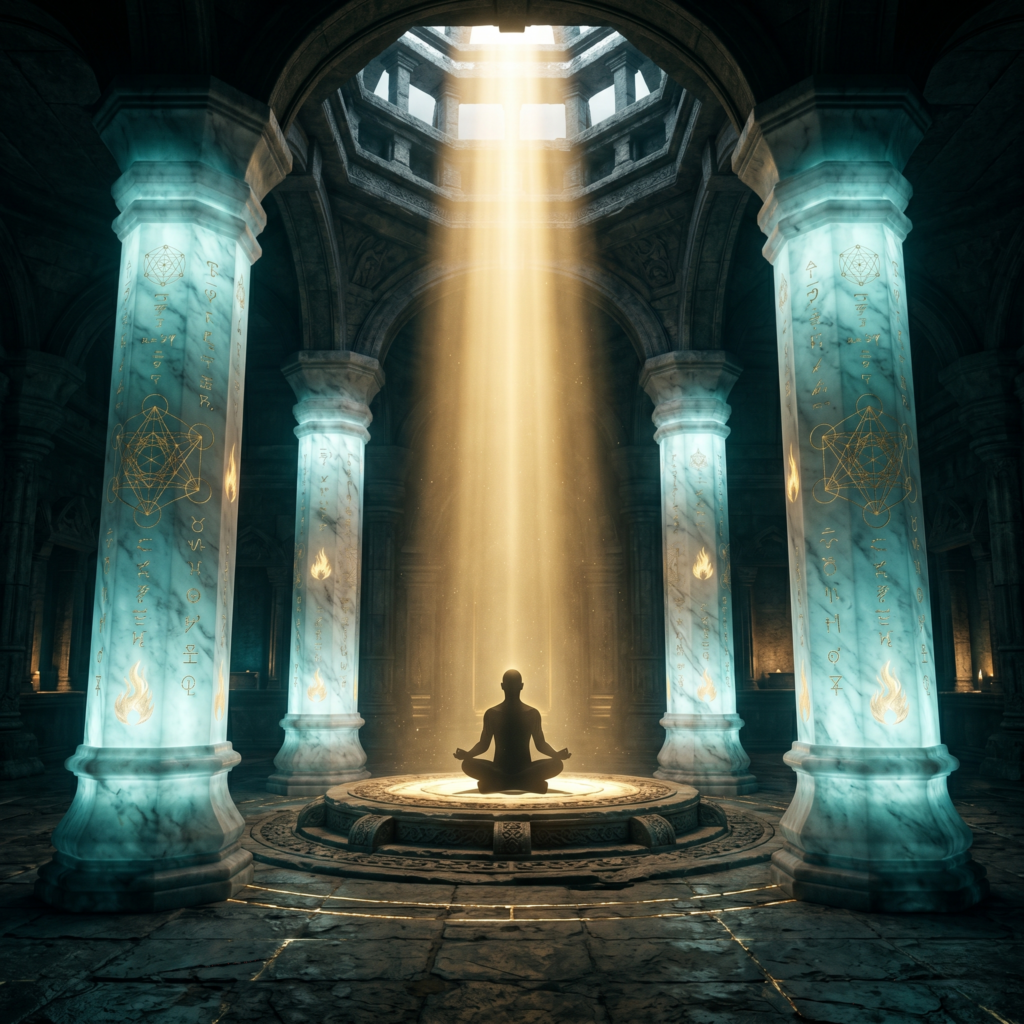
Did four second-century sages hold the precise keys for activating the pillars of gnosis? During an era of profound spiritual confusion, a select group of esoteric masters refused to settle for blind faith. Instead, they created a map for the awakening of consciousness.
This system did not rely on unbending dogma, but on the perfect balance of four universal forces. Their names do not appear in official history, however, and their teachings were fragmented, leaving later seekers with an incomplete vision of the inner work.
Today we discover that their individual legacies sustain this grand structure. If you want to understand how these masters defied their time and what hidden tools they left for your own self-realisation, it is essential to delve into their mysteries. The journey to activate the pillars of gnosis begins here!
Basilides and the Scientific Approach to the Gnostic Pillars
The first axis of this knowledge presents itself as a purely verifiable investigation. By studying Basilides the Gnostic, we discover that he approached spiritual awakening with the precision of a scientist. For this Alexandrian master, enlightenment was not a matter of blind faith but the direct result of understanding exact and measurable cosmic laws.
Psychological Science and the Dissolution of the Appendages
Basilides explained a fundamental concept for inner work: the appendages of the psyche. He explained in a scientific manner that our pure Essence is trapped by aggregates or foreign elements. Through conscious self-observation, the student can identify these mechanical forces that alter their behaviour and condition their destiny. This methodology turns introspection into an exact science, providing one of the most solid foundations to the pillars of gnosis.
Ptolemy and the Philosophical Approach to the Pillars of Gnosis
True philosophy does not consist in accumulating abstract theories, but in a completely conscious way of living. The master Ptolemy the Gnostic structured esoteric teachings to serve as a shield against the difficulties of the world. His approach teaches the student to use reason, not for debate, but to analyse their own reactions to everyday events.
Elevating our Inner State in the Face of Circumstances
The value of this discipline lies in learning to elevate our inner state through reflecting on the events of daily life. Ptolemy invites us to understand that life is full of fleeting events that arise mechanically. By applying constant philosophical discernment, we prevent external problems from disturbing our inner peace. Thus, daily crises are transformed into material for study and circumstances cease to govern us, consolidating one of the most practical bases of the pillars of gnosis.
Marcus the Magician and Conscious Art in the Pillars of Gnosis
Secret knowledge has never been limited to the pages of a book; it is also expressed through beauty and mathematical vibration. By studying Marcus the Gnostic, we discover how sacred art becomes an instrument of transformation. This master did not conceive of art as mere entertainment, but as a precise technique to elevate our inner state.
The Magic of the Word and Vibrational Harmony
Marcus taught that every word spoken and every sound emitted has the power to modify our internal energy. Through the conscious use of mantrams and correct vocalisation, the student learns to tune their inner world to the frequencies of the cosmos. This art of the word demands that we take care of what we express and what we listen to on a day-to-day basis. By transforming our expression into a harmonious work of art, we activate the creative force that sustains the pillars of gnosis.
Valentinus and the Pillar of Religion among the Pillars of Gnosis
The pillar of Religion is not founded upon dogmas of blind faith, but on re-ligare: the mystical and direct union of consciousness with the Being. By studying the legacy of Valentinus the Gnostic, we discover the foundations of superior devotion and the soul’s yearning to return to the Absolute. This great master taught that spirituality is not an intellectual theory, but a direct experience achieved through the awakening of consciousness.
The Essence and Union with the Intimate
The Valentinian doctrine focuses on the rescue of our Essence, which is bottled up within our psychological aggregates. To achieve the return to the Great Reality, Valentinus taught the need to purify oneself through the transmutation of our creative energies. This esoteric experience constitutes the mystical base that completes the pillars of gnosis with absolute perfection.
Thanks to this inner discipline, the student consciously activates the pillars of gnosis in their own life.
Four Masters, One Synthesis: The Pillars of Gnosis
The wisdom transmitted by these four early masters does not belong to the past. By uniting the scientific rigour of Basilides, the philosophical clarity of Ptolemy, the artistic vibration of Marcus, and the religious love of Valentinus, we obtain a completely balanced system to revolutionise our consciousness. Developing these four areas in our daily life is the path to activate the true pillars of gnosis and achieve the awakening of our consciousness and self-realisation.
Share this Knowledge: Has the legacy of these early sages inspired you? We invite you to share this article on your social networks to help other seekers discover the fundamental pillars of gnosis and expand universal esoteric wisdom.
Subscribe to the Blog: If you wish to receive our upcoming articles, analyses of ancient texts, and practical keys for inner development free of charge directly to your email, enter your details in the subscription form below.
Leave us your Comment: Which of these four masters or pillars do you feel a greater affinity with at your current stage of inner searching? We want to know about your experience; leave us your opinion or question in the comments section to open up a space for reflection together.
Subscribe to our blog!