

Have you experienced a feeling of peace while walking through a forest, visiting a lake, or feeling the sea breeze?
The physical and psychological benefits of being in contact with nature are becoming increasingly well-known, with scientific studies confirming what is intuitively felt.
In countries such as Japan, people engage in what is known as “forest bathing”. Likewise, the practice called “grounding” has gained significant popularity, and it has been shown that walking barefoot on the earth for more than half an hour reduces cortisol levels. Science is truly wonderful when it is properly used and applied in medicine for the purpose of healing!
Beyond the beauty of nature itself, do you believe that there is something more in these places that brings you a sense of calm?
Could it be that the elementals of nature are what lead you to experience peace and harmony?
Since the earliest times the elementals of nature, have been spoken of. These are the spirits of the natural world that dwell in places such as those mentioned above.
Beyond the relaxing effect of escaping daily noise, breathing fresh air and contemplating breathtaking landscapes, there is another aspect of nature that is more mysterious. We are talking about the spirit of nature, or the elementals of nature. In pre-industrial times, knowledge of these elementals was common and widely accepted. In many countries this ancient knowledge continues to make itself felt through traditions and folklore.
In Iceland, for example, human building activities are influenced by ancient traditions surrounding the Huldufólk, the “hidden people” or elves of Icelandic folklore. Although there are no laws that officially recognise their existence, many communities request the protection of certain rocks, hills and landscapes considered sacred or magical. This cultural respect has led to roads and development projects being altered in order to avoid disturbing places associated with folklore.
The Elementals of Nature in History
If we study the history of medieval Europe, we can find references to elementals in numerous paintings, sculptures, engravings and other art. They also appear among the Nahuals, such as the Nahual chaneque in Mexico, as well as in the statue of the Pombero, a Guaraní goblin preserved in the Ramón Elías Museum in Paraguay—an elemental recognised in Paraguay, Brazil and northern Argentina.
In 1566, Paracelsus, the renowned Swiss physician and astrologer, published his work The Book of Nymphs, Sylphs, Pygmies, Salamanders and Other Spirits. In this book, Paracelsus describes the sylphs and sylphides of the air, also known as fairies. They are portrayed as beings of ineffable beauty, moving harmoniously through the air. Numerous references to these spirits of the air can be found throughout history.
We also encounter them in Shakespeare’s A Midsummer Night’s Dream, which revolves around a wedding and the fairies of the forest. In Homer’s The Odyssey, Odysseus and his crew embark on a series of adventures in which they encounter water elementals known as undines and nereids.
Similarly, in Richard Wagner’s operatic cycle The Ring of the Nibelung, several river nymphs of the Rhine appear. They are the guardians of the treasures of the river. This contains hidden symbolism: the treasure represents what is most valuable within the human being—the energy contained in the waters of life.
Paracelsus’ work has even inspired children’s stories. Unfortunately, in modern times it has been relegated to the realm of fantasy. Even so, it conceals a truth that remains hidden from the masses. Those who possess sufficient consciousness are able to comprehend these mysteries.
What Are the Elementals of Nature?
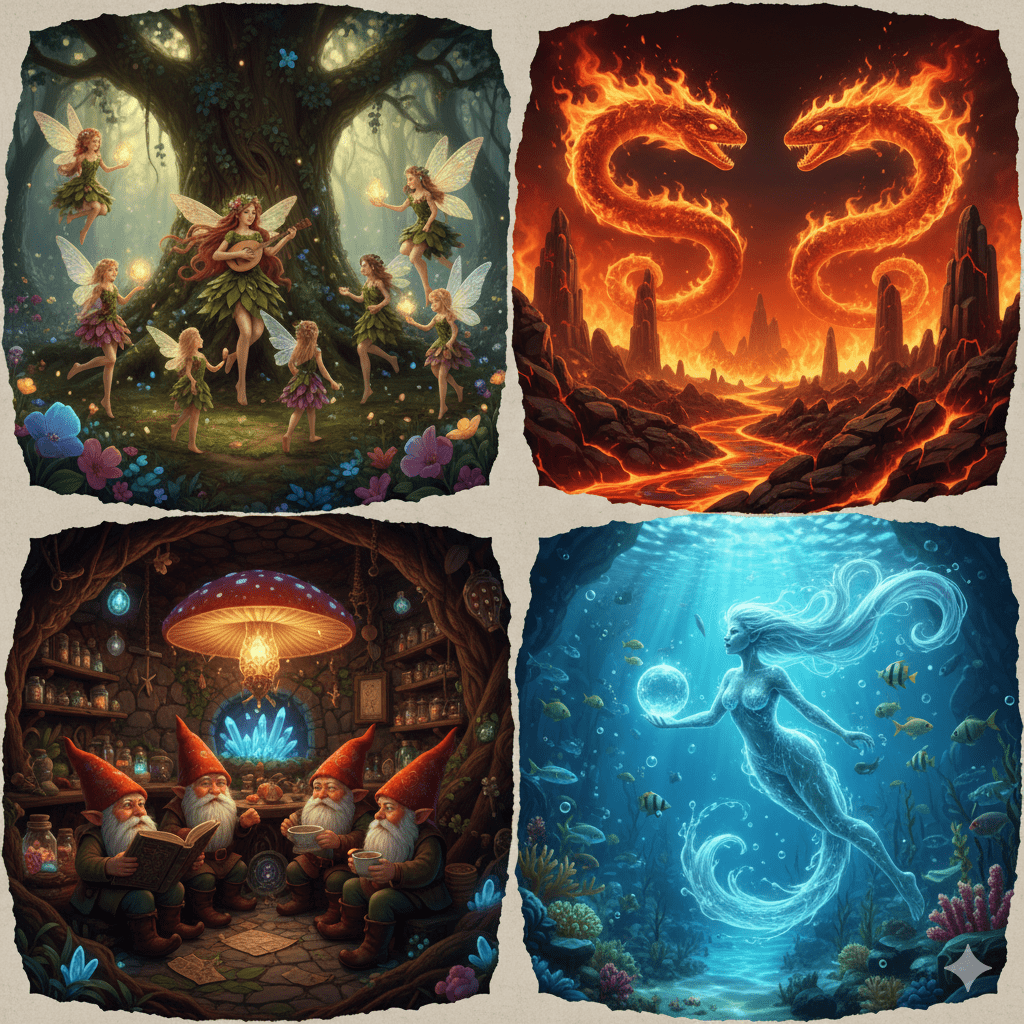
Elementals are the spirits or souls of the elements. Which elements are we referring to? Earth, water, air, fire and ether. Aristotle affirmed that the heavens were composed of ether—also known as the fifth element—and that this filled the regions of space. In essence, elementals are the life force that animates these elements.
The Venerable Master Samael Aun Weor, in his book Igneous Rose, explains that there is no forest without its genie, no tree without its spirit (elemental). There is no tree without a soul. Every plant is the physical body of an elemental creature of nature. The elementals of plants play like innocent children. Gnomes and pygmies are the spirits that govern the element of earth, the minerals of our planet.
Likewise, just as plants and minerals serve as physical bodies for elemental beings, animals are also the physical expressions of elemental creatures of nature.
These elementals inhabit the fourth dimension, or hyperspace, which is why we cannot normally perceive them. However, they have allowed themselves to be seen throughout human history, and for this reason they are known in folklore and works of art in their forms of fairies, pixies, salamanders and gnomes.
These elementals of nature have always existed on our planet, entering the evolutionary wave at the very dawn of creation.
Where Else Are These Elementals Found?
The elements are also present within our physical constitution. They are forces that exist within us—in our thoughts, emotions, instincts and movements. For example, the energy reflected in the element of fire is related to passion. Emotions are associated with the element of water. Thought corresponds to air, particularly in its negative expression as restless mental whirlwinds. Earth relates to stability and work, or, in its negative aspect, to inertia.
However, these “inner elements” can be influenced by egos such as laziness, anger, pride or lust, causing profound imbalances within us which, in turn, affects the health of our physical organs. When we are in harmony—for example, after practising meditation—the peace we experience allows us to perceive how these elementals work within us.
These elements have their own Gods with specific names. We can invoke these Gods in order to heal and harmonise ourselves. Day by day, we can cultivate friendship with the elementals through simple practices whenever we are in contact with them, like the element water when we are having a shower. Whenever we are in natural environments—rivers, lakes, or on the sand of the beach – we can connect with the elementals of nature.
The possibilities are endless and within everyone’s reach. All that is required is faith, practice and knowledge. The Venerable Master Samael Aun Weor teaches that it is not the plant itself that heals, but the elemental or spirit of the plant that brings about healing.
If this topic interests you, share this article and subscribe to the blog, so you may continue discovering this wonderful world of knowledge that is for the benefit of all humanity.
Subscribe to our blog!
